Aylesbury’s Victorian and Edwardian chimney stacks are among the most neglected elements of local housing stock. Decades of freeze-thaw cycles erode mortar joints, lead flashings fail, and pots crack — all allowing water into the very structure of your home.
The Victorian terraces around Cambridge Street, Temple Street and the Kingsbury quarter have chimney stacks built in the late 19th century. Original lime mortar joints, soft red brick, and hand-made clay pots are the norm. After 100–130 years of Buckinghamshire winters, the mortar haunching that beds the chimney pots is typically cracked or absent, the lead flashing at the stack base has perished, and repointing is required on multiple courses.
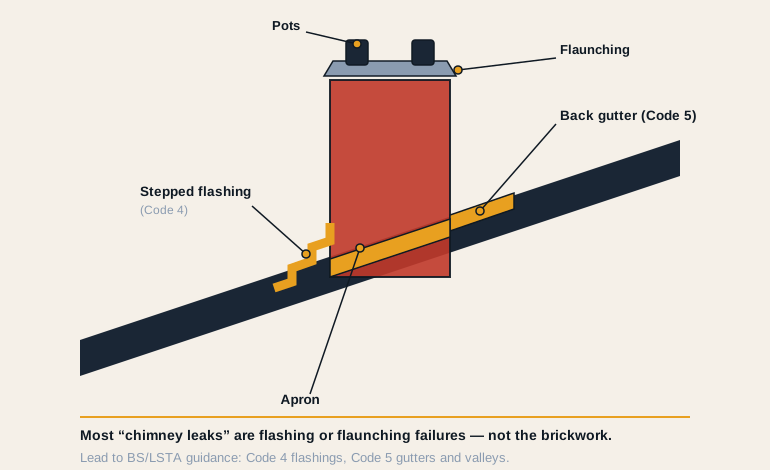
On 1960s and 1970s properties across Bedgrove and Elm Farm, the chimney stacks are a different problem: cement-based flaunching that was applied over old mortar has cracked and lifted, the lead or zinc step flashings have failed at the upstand, and concrete pots have developed hairline cracks that allow water ingress directly into the flue.
We carry out all aspects of chimney repair: full repointing of stacks using matched lime or hydraulic lime mortar; haunching repair and replacement to secure existing pots; new lead step and soaker flashings; pot replacement with matched or improved profiles; and full stack rebuilds where structural integrity is compromised.
Pot re-bedding and haunching repair: £150–£350 per stack. Lead flashing replacement (full stack): £400–£800. Stack repointing (full): £300–£700. Complete chimney rebuild: £1,500–£4,000+ depending on stack height and access. All work quoted upfront.
Need a quote today? Our team covers all of Aylesbury and the surrounding area.
Call 0129 670 6028Chimney problems often show up as damp inside. Here is how to tell the stack is the source.
When it is not the answer: If the stack is beyond economic repair — badly leaning, extensively spalled — rebuilding or removing it may be better value than repeated repairs; we give an honest view. Read the full guide.
We inspect all four faces of the stack, the flaunching, pots and flashings — not just the visible side.
The scope — repointing, flaunching, flashing, pots — with the correct mortar specified for the property age.
Two-storey stack work needs scaffold, confirmed and included in the quote.
Repointed in matching mortar, flaunching renewed, lead flashings dressed to BS6915, pots re-set or replaced.
10-year workmanship guarantee issued in writing.
| Job | Typical duration |
|---|---|
| Flaunching replacement | Half a day |
| Full stack repointing | 1–2 days |
| Lead flashing renewal | Half to one day |
| Pot replacement | Half a day |
Mortar and flaunching need dry conditions to cure; we schedule stack work around the forecast.
Stack-level work needs scaffold for safety on two-storey properties; we never work a chimney off a ladder. Scaffold is specified for: all two-storey stack work — it is standard for chimney repairs - always itemised in your written quote, never a hidden extra, and we arrange it.
Aylesbury's mix runs from post-war and 1970s estate semis on Bedgrove, Southcourt and Quarrendon — open-access, straightforward scaffold — to the tight lanes of the Old Town conservation area and the village cores of Long Crendon and Bierton, where pavement space is limited and scaffold needs planning. Pavement scaffold and skip permits go through Buckinghamshire Council; allow a few working days on streets like Church Street, Parson's Fee, Temple Street where space is tight.
| Job | Typical range | Notes |
|---|---|---|
| Flaunching replacement | £200–£450 | Around the pots |
| Full stack repointing | £350–£700 | Correct mortar for age |
| Lead flashing renewal | £250–£500 | To BS6915 |
| Pot replacement, fitted | £150–£350 | Per pot |
| Combined repoint + flaunching + cowl | £600–£900 | Scaffold included |
Worked example: A full repoint and re-flaunch on a 1930s semi stack, scaffold included, runs about £750.
Staged on larger stack work; nothing before scaffold and materials on site. VAT included.
Covering HP17, HP18, HP19, HP20, HP21, HP22 and surrounding postcodes.
Chimney workmanship is covered for 10 years; correctly repointed in the right mortar, a stack lasts decades.
If a fault appears in covered work, we come back and put it right. No quibbling, no re-charge.
Scaffold up for the duration and some noise; the work is external and the interior is undisturbed. You do not need to stay home for external work - we just need power and access agreed in advance.
Repointing and flaunching need dry, above-freezing conditions to cure properly; we plan around the weather. The Vale of Aylesbury sits open to the prevailing south-westerly weather across flat farmland, and the low-lying clay around Southcourt holds damp longer in autumn, slowing drying times.
"Victorian chimney on our Cambridge Street terrace was leaking into the bedroom wall. Survey identified failed haunching, cracked pot and perished lead flashing. They sorted all three in one visit. No more damp, no more smell in the bedroom fireplace."
"Spotted the chimney stack leaning slightly from the garden — called and they came out the next morning. Confirmed it was safe but required full repointing and new flashing. Work completed within the week. Very professional approach."
"Three chimney pots re-bedded and the full stack repointed in lime mortar. The finish is excellent and the surveyor noticed a cracked fourth pot we hadn't spotted — they replaced it at no extra call-out. Very thorough."
We cover Aylesbury and a 15-mile radius. Click your town for local pricing, housing-specific advice, and availability.
Visible signs include missing or crumbling mortar between bricks, cracked or absent haunching around chimney pots, mortar debris in the fireplace or gutter, damp patches on the chimney breast wall inside, and gaps visible between the lead flashing and the stack base. Any one of these warrants a professional inspection.
Hairline cracks in the mortar joints of a Victorian stack are common and not immediately dangerous. Cracks in the brickwork itself, a visibly leaning stack, or any movement at the base of the stack are cause for urgent inspection. If in doubt, call us — we will assess it and tell you honestly.
Yes. For Victorian and Edwardian stacks built with original soft brick, we always use hydraulic lime mortar matched to the original. Using hard Portland cement on old brick accelerates deterioration — the cement does not flex with the stack, causes spalling, and forces moisture into the brickwork. We match the mortar to the property age.
We carry out drone surveys for initial inspection. For repair work, ladders with roof ladders are sufficient for many single and two-storey terrace stacks. For larger stacks, fully supported scaffolding is required and is included in our quote. We always prioritise safe working and will not attempt repairs from unsafe access positions.
From the ground with binoculars: look for mortar joints that are visibly recessed (more than 10mm deep), crumbling, or absent. Mortar debris on the roof slope below the stack is a reliable indicator. From inside the property: a damp chimney breast wall — particularly one that worsens in winter — often indicates failed pointing or haunching rather than a flashing problem. Both should be investigated by getting onto the roof.
Yes, where appropriate. Properties built before 1919 — the Victorian and Georgian stock in Aylesbury's town centre and conservation area — should have chimney pointing and haunching done in a lime-based mortar matched to the original specification. Cement mortar on old soft brick causes spalling damage over time as moisture migrates into the brick face rather than the joint. We specify mortar by property age and brick type, not by default.
Yes. If the chimney is completely redundant and is a maintenance liability, removal is an option. The process involves taking down the stack above the roofline, making good the roof covering where the stack was penetrating, and ensuring the flue below is correctly capped and vented. On conservation area properties, removal of a chimney visible from a highway requires planning permission. We survey and advise on the options including the planning position.
No call-out fees. No obligation. Just an honest quote from a local Aylesbury roofer.
0129 670 6028 ✉ Email Us