Lead valleys, step flashings, chimney back gutters, flat roof bays and dormers — lead work is the most durable weatherproofing material available and lasts 50–100 years when correctly installed. We work to BS6915 standard on all lead applications across Aylesbury.
Lead remains the premium roofing material for junctions, flashings and valley work, and for good reason: a correctly formed Code 4 or Code 5 lead valley or chimney back gutter will outlast every other element of the roof. The Victorian and Georgian properties in Aylesbury’s town centre — Cambridge Street, Temple Street, the Kingsbury quarter, and properties around the Market area — have original lead valleys and chimney flashings that, if maintained, can continue to serve for generations.
The most common lead work failures we attend in Aylesbury are: perished step flashings at chimney stacks on Victorian stock that have dried and cracked at the turndown; short-clipped soakers that have lifted over decades of thermal movement; lead valleys that have been covered over with mortar by previous contractors (a damaging practice that restricts thermal movement and causes splitting); and gutter linings on flat-roof dormers where original lead has been patched with incompatible materials.
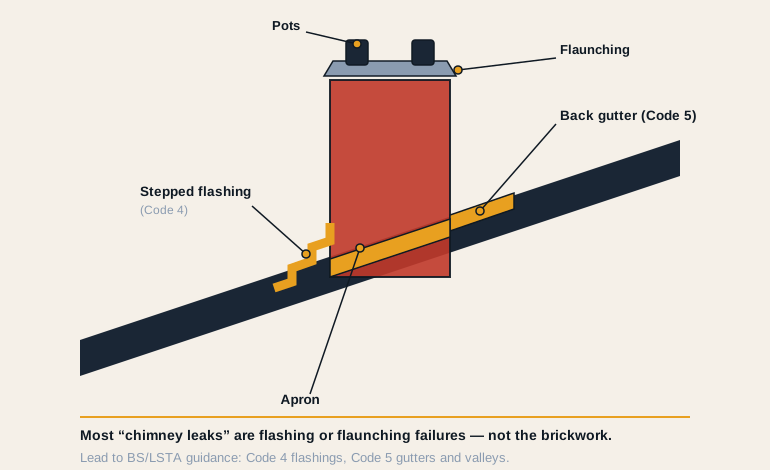
We use Code 4 lead for flashings and soakers, Code 5 for valleys and gutters, and Code 6 for flat roof applications. All lead work is formed to BS6915 with correct bay lengths (1.5m maximum to allow free thermal movement), correct drips, and proper fixings that allow expansion without stress.
Chimney step and cover flashings. Valley linings (open or closed). Abutment flashings. Dormer cheek and top flashings. Bay window flat roof linings. Flat roof-to-wall upstands. Parapet gutter linings. Lead soakers to slated roofs. Historic repair and lead-to-lead welding on period properties.
Need a quote today? Our team covers all of Aylesbury and the surrounding area.
Call 0129 670 6028Leadwork protects the joints where roofs meet walls and chimneys. Here is how to tell yours needs attention.
When it is not the answer: If a flashing only needs re-dressing rather than replacing, we do the lesser job — we do not replace sound lead to inflate a bill. Read the full guide.
We assess the lead code, bay lengths and condition against BS6915 and identify what actually needs renewing.
The correct lead code and scope specified, with the price fixed.
Scaffold arranged where the work is at height, included in the quote.
New lead laid to correct code and bay lengths, dressed properly, patination oil applied.
10-year workmanship guarantee; correctly laid lead has a 60–100 year design life.
| Job | Typical duration |
|---|---|
| Chimney or abutment flashing | Half to one day |
| Valley re-lead | 1–2 days |
| Bay or dormer coverings | 1–2 days |
Leadwork runs in most weather; heavy rain pauses work at height for safety.
Lead flashing and valley work usually needs scaffold for safe standing time at height. Scaffold is specified for: valley, bay and most flashing work at two-storey height - always itemised in your written quote, never a hidden extra, and we arrange it.
Aylesbury's mix runs from post-war and 1970s estate semis on Bedgrove, Southcourt and Quarrendon — open-access, straightforward scaffold — to the tight lanes of the Old Town conservation area and the village cores of Long Crendon and Bierton, where pavement space is limited and scaffold needs planning. Pavement scaffold and skip permits go through Buckinghamshire Council; allow a few working days on streets like Church Street, Parson's Fee, Temple Street where space is tight.
| Job | Typical range | Notes |
|---|---|---|
| Chimney or abutment flashing | £350–£700 | |
| Valley re-lead | £500–£1,200 | |
| Bay or dormer coverings | £600–£1,200 | |
| Lead repair / re-dress | £250–£500 | Where sound |
Worked example: Re-leading a valley on a Bierton property to correct code runs about £800, scaffold included.
Staged on larger leadwork; nothing before scaffold and materials on site. VAT included.
Covering HP17, HP18, HP19, HP20, HP21, HP22 and surrounding postcodes.
Leadwork carries our 10-year workmanship guarantee; laid to BS6915 standard, lead lasts 60–100 years.
If a fault appears in covered work, we come back and put it right. No quibbling, no re-charge.
External work with scaffold up for the duration; the interior is undisturbed. You do not need to stay home for external work - we just need power and access agreed in advance.
Leadwork runs year-round, pausing only for safety in high winds or heavy rain. The Vale of Aylesbury sits open to the prevailing south-westerly weather across flat farmland, and the low-lying clay around Southcourt holds damp longer in autumn, slowing drying times.
"Victorian terrace in the Kingsbury area β chimney flashings had been patched by several previous contractors over the years. Complete lead replacement to the correct standard, BS6915 confirmed. No more leaks and the stack looks right."
"Lead valley had been filled with mortar β apparently done years ago. They stripped the whole lot out, re-formed the valley in Code 5 lead with proper bay joints, and the roof has been dry all winter. Expensive job but done properly."
"Bay window lead lining had failed at every corner. New Code 5 lining installed with correct drips and upstand. The quality of the forming is exceptional β you can see it's been done by someone who knows what they're doing."
We cover Aylesbury and a 15-mile radius. Click your town for local pricing, housing-specific advice, and availability.
We use Code 4 (1.8mm) for flashings, soakers and abutments; Code 5 (2.24mm) for valley linings, dormer flashings and back gutters; and Code 6 (2.65mm) for flat roof bay linings and parapet gutters. All work is to BS6915.
Lead forms to irregular surfaces perfectly, requires no sealants or adhesives, lasts 50β100 years when correctly installed, and is fully recyclable. For Victorian and Georgian properties in Aylesbury where the junction geometry is complex and conservation character matters, lead remains the superior choice.
The main causes are: thermal movement cracking where bays are too long or fixings are too tight; oxidation drying at the turndown edge over many decades; mortar overfilling blocking movement; and mechanical damage from previous repair attempts. Short-bay lead correctly installed with code-appropriate thickness will not fail for 50+ years.
Yes. For listed buildings we ensure all lead work meets the material specification requirements of the listing. We work with the Buckinghamshire Council conservation officer process where consent is required and use traditional hand-bossing techniques where required on historic properties.
Resealing is appropriate for a lead flashing where the lead itself is sound but a joint has opened slightly or a sealant bead has failed. Replacement is needed when the lead has cracked through (visible splits across the face of the lead), when it has pulled out of the mortar joint entirely, or when the lead is visibly corroded thin. We assess the actual condition on the roof and give you a straight recommendation β we don't default to replacement where repair is viable.
Step flashing is built into the wall of the chimney stack during construction β individual lead pieces stepped up the stack in line with each tile course. Cover flashing (or cap flashing) is dressed over the top of the step flashing and into a mortar joint in the brickwork, sealing the top edge of the step flashing against the wall. On older Aylesbury properties, the cover flashing commonly fails at the mortar chase while the step flashing beneath is still sound β in this case only the cover flashing needs replacing.
Lead has a higher upfront cost than some alternatives β a standard chimney flashing in lead costs more than the same job in aluminium or zinc. However, correctly installed Code 4/5 lead to BS6915 standard has a lifespan of 60β100 years, significantly outperforming most alternatives. On a 50-year lifecycle cost basis, lead is often comparable to or cheaper than alternatives that need replacing every 20β30 years. We specify the most appropriate material for the application and budget.
No call-out fees. No obligation. Just an honest quote from a local Aylesbury roofer.
0129 670 6028 ✉ Email Us