Repair or Replace? An Aylesbury Roofer's Honest Guide
The question every homeowner asks — and the one a roofer should answer honestly, both ways. Here is how to tell whether your roof needs a repair, a re-fix, or a full replacement.
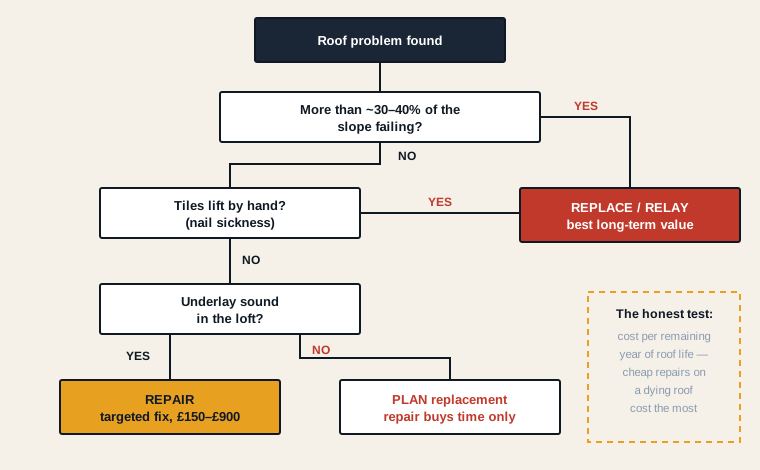
Repair if the failure is localised — a few slipped tiles, one flashing, a sound felt underneath. Replace if more than about a third of the covering has failed, the felt is perished across the roof, or you are paying for repeat repairs every year. The rule of thumb: when annual repair costs exceed the cost-per-year of a new roof, replacement is the better value. Free honest survey — call 0129 670 6028.
✓ NFRC Registered
✓ Fully Insured
✓ 10 Year Guarantee
✓ Free Quotes
✓ No Hidden Costs
✓ Local Since 2004
The Core Question
When Should You Repair a Roof, and When Should You Replace It?
It is the most important — and most abused — question in roofing. Some firms reflexively recommend a full re-roof because it is the bigger invoice; others patch a roof that is clearly finished because a repair is an easier sell. The honest answer depends on three things: the age and condition of the roof, how much of it has actually failed, and the state of the felt underneath. Get those right and the decision usually makes itself.
Repair or replace — the decision at a glanceBy Age & Stock
The Age and Condition Matrix for Aylesbury Roofs
Aylesbury's housing gives a fairly reliable guide. The 1960s–80s concrete-tile estates — Bedgrove, Southcourt, Quarrendon — are now at the age where nail sickness and perished felt push many roofs toward replacement; a concrete interlocking tile roof has a 40–50 year design life, and much of that stock is at or past it. The post-war housing is older still. By contrast, a well-maintained natural slate roof on a period property can run far longer with periodic repair, and clay tile sits somewhere between.
So the same symptom means different things on different stock. A dozen slipped tiles on a 15-year-old roof is a straightforward repair; the same on a 50-year-old Bedgrove roof with perished felt is often the first visible sign that the whole covering is failing. Age is not the only factor, but it frames the decision.
The Money
Cost-Per-Remaining-Year: The Logic That Settles It
The way to cut through the sales pressure is simple arithmetic. A repair buys you a certain number of trouble-free years; a re-roof buys you 40–50. Divide the cost of each by the years it buys and compare. A £400 repair that holds for five years costs £80 a year. A £7,000 re-roof that lasts 45 years costs about £155 a year — but it also ends the repeat repairs, the water damage risk, and the worry.
The tipping point — the widely used rule of thumb — is roughly the 30% rule: when the cost of repairs approaches about a third of the cost of replacement, or when you are facing repeated repairs year after year, replacement becomes the better value. Below that, and where the failure is localised, repair wins. We do this maths with you honestly at the survey.
When Repair Is Money Wasted
The Signs a Roof Is Genuinely Finished
Some roofs are past repair, and continuing to patch them is throwing good money after bad. The clear signs: nail sickness across whole slopes rather than isolated tiles; felt that is perished and crumbling when you look in the loft, letting daylight through; sagging in the roofline indicating tired timber; and a pattern of repeat repairs, each a little further along than the last. When several of these are present together on an ageing roof, a re-roof is the honest answer, and we will say so plainly.
When Replacement Is Oversell
And the Signs You're Being Sold Too Much
Equally, plenty of roofs are sold a needless replacement. If the failure is genuinely localised — one slope, a single flashing, a run of tiles — and the felt beneath is sound, a repair or a re-fix is the correct, far cheaper answer. Nail sickness limited to one elevation with good felt does not need a whole-roof re-tile; it needs that slope re-fixed with stainless nails. If a roofer quotes a full re-roof without getting up to check the felt, or pressures you to decide on the spot, be sceptical — that is the behaviour our guide to choosing a roofer warns about.
Our position is the same both ways: we would rather do the right £400 repair and keep you as a customer for the eventual re-roof than sell you a £7,000 job you do not yet need.
How to Decide
Getting an Honest Answer for Your Roof
The only way to know for certain which side of the line your roof falls is a proper survey — someone on the roof, testing the tiles, and crucially checking the felt in the loft. A glance from the ground cannot tell you whether that felt is sound, and the felt is what decides it. Our survey is free, the report is written and honest, and if the answer is 'repair, and it'll hold for years', that is exactly what we will tell you. Book a survey and get a straight answer — call 0129 670 6028.
Material Lifespans
How Long Each Roof Type Lasts — and What That Means for the Decision
Part of an honest repair-or-replace answer is knowing what you are working with, because different roof coverings have very different lifespans and that changes the maths. Concrete interlocking tiles — the standard on Aylesbury's 1960s–80s estates — have a design life of around 40 to 50 years, so much of that stock is now at the point where replacement rather than repair starts to make sense. Clay tiles last longer, often 60 years or more. Natural slate is the longest-lived of all: a good slate roof can run 80 to 100 years or more with periodic repair, which is why repairing rather than replacing an old slate roof on a period property is so often the right call.
The felt underlay, though, is the hidden clock. Traditional bituminous felt has a shorter life than the tiles above it — typically 30 to 40 years — and once it perishes, the roof has lost its second line of defence even if the tiles look sound. This is why a 50-year-old estate roof with original felt is a replacement candidate regardless of the tiles: the felt has gone, and re-covering with a modern breathable membrane is a large part of what a re-roof actually buys you. It is also why we always check the felt, not just the tiles — it is the component that most often decides the answer.
A Third Option
Don't Forget the Middle Ground: The Partial Re-Roof
The repair-versus-replace question is often framed as binary, but there is frequently a sensible middle option that neither the patch-it nor the replace-everything camp mentions. Where one slope of a roof has failed — nail sickness and perished felt on the rear elevation, say — while the other remains sound, re-covering just the failed slope is often the right answer. You get a new, membrane-backed slope where it is needed without paying for a full roof, and the sound slope carries on until its own time comes.
This partial approach suits a lot of Aylesbury's estate housing, where slopes often face different weather exposure and age at different rates — the wind-and-rain-facing slope typically failing first. A roofer genuinely working in your interest will raise this option where it fits, rather than defaulting to the whole-roof invoice. It is exactly the kind of honest, tailored answer a proper survey produces and a drive-by quote never will.
Repair or Replace FAQ
Frequently Asked Questions
Repair if the failure is localised and the felt underneath is sound — a few slipped tiles or one flashing. Replace if more than a third has failed, the felt is perished, or you're paying for repeat repairs. When annual repair cost nears a third of replacement cost, replacement wins. Free survey — call 0129 670 6028.
A rule of thumb: when the cost of repairs approaches about 30% of the cost of a full replacement — or you're facing repeated repairs year after year — replacement becomes the better value. Below that, and where damage is localised, repair is the sensible choice.
A concrete interlocking tile roof — the common stock on Bedgrove, Southcourt and Quarrendon — has a 40–50 year design life. Natural slate lasts far longer with periodic repair. Much of Aylesbury's 1960s–80s estate stock is now at or past its design life.
If the failure is localised to one slope and the felt is sound, a repair is the honest fix — not a full re-roof. Be sceptical of any roofer who quotes a replacement without checking the felt in the loft, or who pressures you to decide immediately.
Yes, if it's limited to one slope and the felt beneath is still sound — the slope is re-fixed with stainless nails, far cheaper than a re-roof. If nail sickness is across the whole roof with perished felt, replacement is the better value.
The condition of the felt underneath. A glance from the ground can't tell you — it needs someone in the loft. Sound felt means repairs will hold; perished felt means the roof is heading for replacement regardless of the tiles on top.
Yes. Our survey and written report are free with no obligation, and because we'd rather earn your eventual re-roof than oversell you today, the report tells you straight — including when the answer is 'repair, and it'll last years'.