Honest, itemised roof repair pricing for Aylesbury — from a £200 slipped tile to a nail sickness re-fix on a Bedgrove estate. Free survey, written report, no call-out fee and no upsell.
A roof repair in Aylesbury typically costs £150–£900. A single slipped tile is £150–£250; a nail sickness re-fix per slope is £350–£600. Access and material matching are the main cost drivers. Free survey, written report, no call-out fee. Call 0129 670 6028.
✓ NFRC Registered
✓ Fully Insured
✓ 10 Year Guarantee
✓ Free Quotes
✓ No Hidden Costs
✓ Local Since 2004
Roof Repair Pricing
What Does a Roof Repair Cost in Aylesbury?
Most roof repairs in Aylesbury fall between £150 and £900. The exact figure depends on what has failed, how much of it, and whether the roof can be reached safely from a ladder or needs scaffold. A single slipped tile is a modest job; a slope of nail-sick tiles on a Bedgrove and Elm Farm estate, or a failed lead valley on a period property, is a larger one.
The most common repair call across Bedgrove, Southcourt and Quarrendon is nail sickness — the galvanised nails holding 1970s–80s concrete tiles have corroded through, and tiles slip after wind. Re-fixing a slope with stainless nails is far cheaper than a full re-roof and is the right call where the felt beneath is still sound.
What Drives the Price
Access is often the biggest single factor. A bungalow repair reachable from a ladder costs a fraction of the same repair two storeys up requiring a scaffold tower. Material matters too: matching a clay peg tile on a period property in Long Crendon costs more than dropping in a stock concrete tile.
Free, no-obligation survey with a written report. No call-out fee. Scaffold included where required.
A written report is included with every survey — if the honest answer is that a repair will hold for another five years rather than a full re-roof, that is what we tell you. Over-selling a re-roof when a £400 repair will do is the single most common complaint we hear about other firms.
The Federation of Master Builders advises homeowners to get a written, itemised quote for any roofing work and to be wary of traders who pressure a full replacement without first inspecting the roof structure.
Not sure what's wrong up there? Free survey and honest written report — call today.
The Repairs We're Called Out for Most Across Aylesbury
Three repairs dominate the call log across the town, and each maps to a different type of housing. On the 1970s–80s concrete-tile estates — Bedgrove, parts of Quarrendon, Elm Farm — it is nail sickness: tiles slipping after wind because the original galvanised nails have corroded through. On the post-war stock in Southcourt it is ridge and verge mortar failure, where sixty years of thermal cycling has cracked the bedding. On the older village and Old Town properties it is lead flashing and valley failure, where undersized or fatigued lead has finally let go.
Why Accurate Diagnosis Saves Money
The reason a proper survey matters is that the same symptom — a damp patch on a bedroom ceiling — can have half a dozen causes, and fixing the wrong one wastes money. Water tracks along timber before it drips, so the stain is rarely directly below the entry point. We trace the actual source rather than patching the nearest visible defect, which is why our repairs hold and why we don't end up back at the same property three months later.
It also protects you from the classic over-sell. A slope with a dozen slipped tiles from localised nail sickness does not need a £7,000 re-roof if the felt beneath is sound — it needs a £450 re-fix. The only way to know which is to get on the roof and test, which is exactly what a free survey does.
Access & Materials
What Really Drives a Repair Quote in Aylesbury
Two factors move a repair price more than anything else: access and material matching. A repair reachable from a ladder on a bungalow is a fraction of the cost of the identical repair two storeys up needing a scaffold tower — and we will not carry out a two-storey repair off a ladder, because it is neither safe nor good-quality work. On the villages and in the Old Town, matching a clay peg tile or sourcing the correct lead code adds cost over dropping in a stock concrete tile, but it is the difference between a repair that looks right and one that stands out from the road.
Emergency make-safe is a separate, smaller cost from the permanent repair. If tiles come off in a storm we secure the roof against further water entry — tarpaulin, tile strapping, boarding — for £150–£400, then quote the permanent repair separately once conditions allow safe access. We never bundle an inflated emergency figure to take advantage of the urgency.
Insurance & Timing
When a Repair Is an Insurance Job, and When to Act
Not every roof repair comes out of your own pocket. Storm damage — tiles stripped by high winds, impact from a fallen branch, water ingress from a sudden weather event — is typically covered by buildings insurance, subject to your excess. We provide a written damage report on every storm call-out documenting the nature and likely cause of the damage, which most insurers accept in support of a claim without requiring a separate inspection.
Wear-and-tear repairs — nail sickness, aged mortar, perished flashings — are not insurable, because they are maintenance rather than sudden damage. The distinction matters, and an honest roofer will tell you which category your repair falls into rather than encouraging a doomed insurance claim. Timing also matters: a small defect caught early is a cheap repair, while the same defect left through a wet winter becomes a much larger job once water has been tracking into the timber for months.
Why We Don't Do Doorstep Quotes
Reputable roofers do not knock on doors offering to fix a roof they have spotted from the street. That approach — common after storms — is the hallmark of the rogue trader, who quotes high, demands cash up front, and does substandard or unnecessary work. Every genuine repair starts with a proper survey and a written quote you can consider without pressure. If someone knocks claiming your roof needs urgent work, take their details and get an independent survey before agreeing to anything.
Honest advice
Do You Actually Need Roof Repairs?
Most roofs give warning signs before they leak. Here is how to tell a repair is what you need — and when it is not.
A damp patch or brown stain on an upstairs ceiling after rain
Slipped, cracked or missing tiles visible from the ground — common on Bedgrove's 1970s concrete stock
Crumbling mortar along the ridge or verge on post-war estate roofs
Water in the loft or daylight visible through the roof
Debris from the roof — granules or mortar — in the gutters
When it is not the answer: If more than about a third of the covering has failed — widespread nail sickness with perished felt across a whole slope — repairing tile-by-tile is money wasted, and a re-roof is the honest answer. Read the full guide.
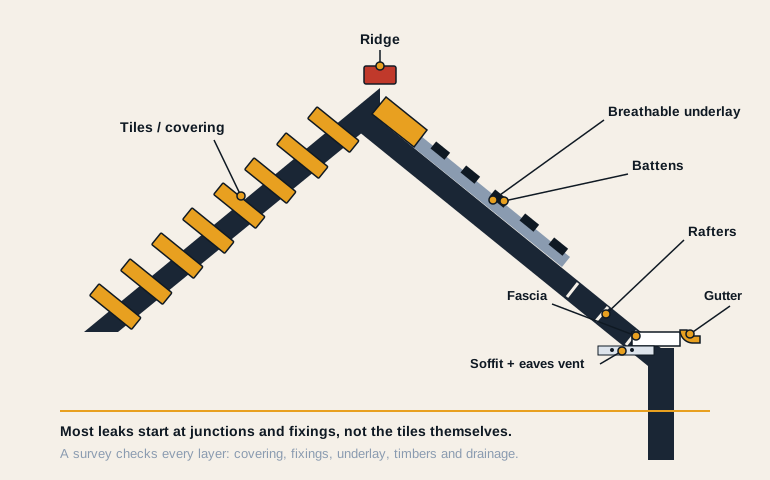
The anatomy of a pitched roof — where repairs are commonly neededThe process
From First Call to Sign-Off
1. Free survey
We get onto the roof, test tiles for nail resistance, and inspect felt, ridges, valleys and flashings. Written report the same day — no call-out fee.
2. Written itemised quote
The exact scope, materials and price broken down line by line, with scaffold or tower access shown separately so you can see what you are paying for.
3. Scheduling
Most repairs are booked within the week; emergency make-safe is available 24/7.
4. The work
Matched tiles, stainless fixings, correct lead code — the repair done to last, not patched.
5. Cleanup & sign-off
Debris cleared, site left clean, and the 10-year workmanship guarantee issued in writing.
Timescales
How Long Does It Take?
Job
Typical duration
Single slipped or cracked tile
1–2 hours
Ridge or verge repointing (one elevation)
Half a day
Nail sickness re-fix, one slope
Half to one day
Lead flashing or valley repair
Half to one day
Wet or high-wind days pause tiling work — we build weather margin into every booking and never leave a roof open.
Access
Access, Scaffolding & Permits in Aylesbury
Most Aylesbury repairs run from a tower or roof ladder; scaffold is quoted only where the job needs safe standing time at height. Scaffold is specified for: chimney-side repairs, full valley rebuilds, and any two-storey work beyond a single day - always itemised in your written quote, never a hidden extra, and we arrange it.
Aylesbury's mix runs from post-war and 1970s estate semis on Bedgrove, Southcourt and Quarrendon — open-access, straightforward scaffold — to the tight lanes of the Old Town conservation area and the village cores of Long Crendon and Bierton, where pavement space is limited and scaffold needs planning. Pavement scaffold and skip permits go through Buckinghamshire Council; allow a few working days on streets like Church Street, Parson's Fee, Temple Street where space is tight.
Pricing
Aylesbury Roof Repairs: Cost Guide
Job
Typical range
Notes
Single slipped or cracked tile
£150–£250
Ladder or tower access
Nail sickness re-fix, per slope
£350–£600
Stainless nails, felt sound
Ridge or verge repointing
£300–£600
Per elevation
Lead flashing repair
£250–£500
Chimney or abutment
Valley repair
£300–£700
Lead or mortar
What moves the price
Access — ladder-reachable versus two-storey scaffold
Whether the felt beneath is sound or perished
Matching a period clay tile versus a stock concrete tile
The extent — one slope or several
Worked example: A slipped-tile repair on a Bedgrove semi, reachable from a tower, runs about £220 including access — done inside the hour.
No deposit on repairs under £500; you pay on completion. No payment is ever taken before materials are on site. VAT included in every quote.
Covering HP17, HP18, HP19, HP20, HP21, HP22 and surrounding postcodes.
Guarantee
The Guarantee in Plain Terms
Workmanship on the repaired section is covered for 10 years in writing; any replacement tiles or lead carry their own manufacturer warranties on top.
Covered: workmanship for 10 years, in writing, transferable if you sell.
On top: manufacturer warranties on materials (terms vary by product).
Not covered: storm or impact damage - that is an insurance matter, and we will document it for your claim.
If a fault appears in covered work, we come back and put it right. No quibbling, no re-charge.
Good to know
What It Is Like While We Work
A day of ladder or tower work and a small amount of tile debris — minimal disruption, and no need to be home for external repairs. You do not need to stay home for external work - we just need power and access agreed in advance.
Repairs run year-round, and temporary weatherproofing goes on the same day if rain stops the permanent fix. The Vale of Aylesbury sits open to the prevailing south-westerly weather across flat farmland, and the low-lying clay around Southcourt holds damp longer in autumn, slowing drying times.
Customer Reviews
What Aylesbury Customers Say
★★★★★
"Slipped tiles after a windy weekend on our Southcourt semi. £220 including the scaffold tower, done inside the hour. No upsell, no drama."
Norman H. · Coronation Avenue, Aylesbury
★★★★★
"Nail sickness re-fix on one slope rather than the full re-roof another firm quoted. Saved us over four grand and the roof's been solid since."
Patricia J. · Ingram Avenue, Aylesbury
★★★★★
"Lead flashing repair on our Bierton property — used matching materials and the damp patch on the chimney breast has gone. Fair price, proper job."
Kenneth H. · The Green, Bierton
Roof Repair Cost FAQ
Frequently Asked Questions
Most roof repairs in Aylesbury cost £150–£900. A single slipped tile is £150–£250; a nail sickness re-fix per slope is £350–£600. Access and materials are the main variables. Free survey — call 0129 670 6028.
Any repair above single-storey height needs safe access. We include scaffold or a tower in the quote where the job requires it — we never carry out two-storey repairs off a ladder, as it compromises both safety and work quality.
Nail sickness on the 1970s–80s concrete tile estates — Bedgrove, Southcourt and Quarrendon. The original galvanised nails corrode and tiles slip. We re-fix affected slopes with stainless nails where the felt is still sound.
It depends on the felt and the extent of the problem. If nail sickness is limited to one slope and the felt is sound, a re-fix is far better value. If the felt is perished across the roof, repeated repairs cost more over five years than a re-roof. We give an honest written assessment.
No. The survey and written report are free with no obligation. You only pay if you book the work.
We survey most Aylesbury properties within 48 hours and can often carry out straightforward repairs the same week. Emergency make-safe is available 24/7.
Yes — all repair work carries our 10-year workmanship guarantee in writing. If it fails due to our workmanship within that period, we return and fix it free.