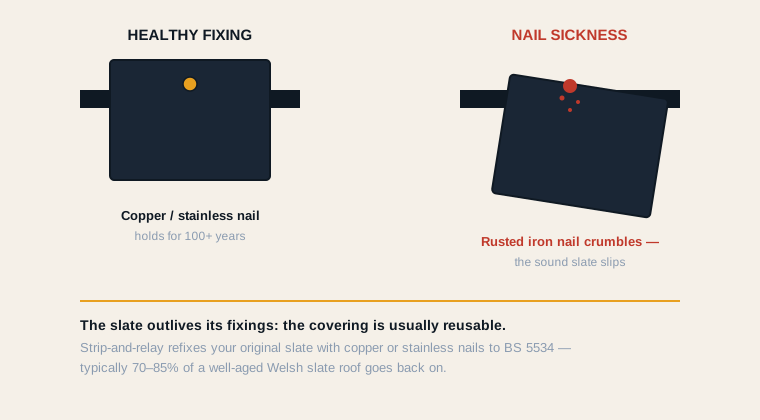
What Nail Sickness Actually Is
When concrete interlocking tiles were laid on the estates built across Aylesbury from the late 1960s through the 1980s, they were fixed using galvanised wire nails driven through a pre-formed hole near the top of each tile and into the batten below. The galvanising gave these nails a design life of roughly 40 years in UK weather conditions.
Those tiles are now 40 to 55 years old. The galvanising has corroded through, the nail shank has rusted and swollen, and in many cases it has corroded entirely at the batten contact point. The tile isn’t falling because it’s held by gravity and the interlocking geometry with adjacent tiles — but the nail is no longer doing its job. One sustained gust of wind, one freeze-thaw cycle working into a gap, and tiles start moving.
Why Aylesbury’s 1970s Estates Are Most Affected
The issue is nationwide for this era of housing, but certain tile profiles are more prone than others. The Redland 49 and Marley Modern profiles fitted across Bedgrove, Walton Court, and Southwood used a wire nail fixing rather than the later two-hole clip system, making them more dependent on nail integrity than profiles built even ten years later.
The Vale of Aylesbury’s clay lowland also creates wetter conditions than higher ground to the south. Properties near the town centre and along Bierton Road experience more sustained damp penetration into the batten zone, which accelerates nail corrosion. North and east-facing slopes — the ones that don’t dry out properly after rain — are typically the first to show movement.
How to Know If Your Roof Has It
From ground level: look for tiles that are sitting proud of the surrounding roof line, or where the horizontal line of a course is no longer straight. After a storm, any tile on the ground is a clear signal. From inside the loft: shine a torch along the batten line and look for rust staining running down from each tile hole, or in advanced cases, visible gaps where tiles should be sitting flat against the batten.
A proper diagnosis requires getting onto the roof and testing tiles individually by lifting the tail — a loose tile with no resistance means the nail is gone. This is not a DIY job; checking incorrectly can move tiles that were marginal into the “failed” category.
Repair or Re-Roof? Making the Right Call
This is the question that most homeowners get conflicting advice on, and the answer genuinely depends on the extent of the problem. If nail sickness affects fewer than 15% of tiles on a given slope, targeted re-fixing with stainless steel ring-shank nails is cost-effective and will hold for another 15 to 20 years. If it’s more widespread — and on the oldest Bedgrove and Elm Farm properties it often is — a full re-roof becomes the more economical choice over a ten-year horizon.
The critical secondary factor is the condition of the sarking felt and battens below the tiles. Felt from the 1970s is typically thin, brittle, and failing at the laps. If the tiles need substantial re-fixing across large areas, the cost of doing the job twice (once now, once when the felt fails) often tips the calculation toward full replacement. We tell you honestly which category your roof falls into after a free survey.
We cover all of Aylesbury and surrounding Buckinghamshire. Free surveys, no call-out fee, 10-year guarantee on all work.
Roof Repairs Aylesbury → or call 0129 670 6028